
Number plate rules.
Plain English.
The UK has strict rules about what a road-legal number plate must look like. Get them wrong and you'll fail an MOT, get pulled, or have your registration withdrawn. Here's the lot — in language a human can read.
What makes a plate legal
Every road plate sold in the UK must be made by a DVLA Registered Number Plate Supplier (we are one). It must be built to BS AU 145e — the British Standard that governs visibility, durability and impact performance.
- Black characters on a reflective white background at the front.
- Black characters on a reflective yellow background at the rear.
- Mandatory Charles Wright font — no italics, shadows or stylised variants.
- Supplier name + postcode + BS AU 145e mark printed on the plate.
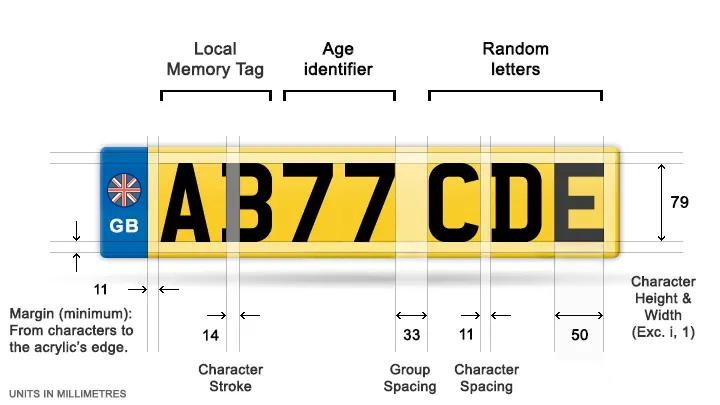
Character sizes & spacing
The dimensions below are not suggestions. They're the law.
Our builder applies legal spacing automatically. You can't accidentally space a plate to spell a word — the system blocks it.
Materials & finishes
Backgrounds must be plain, uniform and fully reflective. That rules out:
- Patterned, textured or carbon-effect backgrounds.
- Honeycomb, tinted or smoked finishes.
- Coloured borders that bleed into the reflective area.
Our acrylic and gel plates use BS AU 145e-certified reflective sheeting. The shine isn't decorative — it's what lets ANPR cameras and headlights see the registration at night.
Are raised characters legal?
Yes — when they're done properly. 3D gel domes and 4D laser-cut acrylic letters are legal on road plates so long as the character shape, height, width and stroke still match the Charles Wright spec, and the background remains fully reflective.
What's not legal: characters thick enough to cast a shadow that distorts the shape, mirror or chrome finishes, and any treatment that obscures the supplier markings.
Approved identifiers
You may display one of the following on the left side of the plate, above a national identifier:
- Union Flag with UK or GB
- Cross of St George with ENG or ENGLAND
- Scottish Saltire with SCO or SCOTLAND
- Welsh Dragon with CYM or WALES
European flags and the GB euro-band are no longer permitted on UK plates. Anything outside the approved list — football crests, regional flags, sponsor logos — is illegal.
Motorbike plates
Motorbikes registered after 1 September 2001 only need a rear plate, and it must be displayed in a two-line format. Character spec is smaller: 64 mm tall, 44 mm wide, 10 mm stroke, with 10 mm between characters and 30 mm between groups.
Show plates
Show plates are for display, track days, garage walls and off-road vehicles. They can ignore font, spacing and reflectivity rules — but they must not be fitted to a vehicle used on a public road. Fitting a show plate on the road carries the same penalties as any other illegal plate.
What happens if you get it wrong
- Up to a £1,000 fine from the police.
- Instant MOT failure.
- The DVLA can withdraw your registration — including personalised plates you've paid for.
- ANPR misreads can flag your car as untaxed or uninsured.
Quick answers
Yes — provided the characters use the Charles Wright font, correct sizing and spacing, a reflective background and the required supplier markings. Decorative finishes that distort the character shape are not legal.
No. Road plates must be fully reflective with black characters. Tinted, smoked or coloured backgrounds will fail an MOT and can earn a fine.
Cars need both. Motorbikes only need a rear plate, and it must be two-line.
No. Spacing is fixed by law. Re-spacing characters to form a name or word is the most common reason plates are rejected.
Up to a £1,000 fine, instant MOT failure, and the DVLA can withdraw your registration.